
A Koan on the Moon
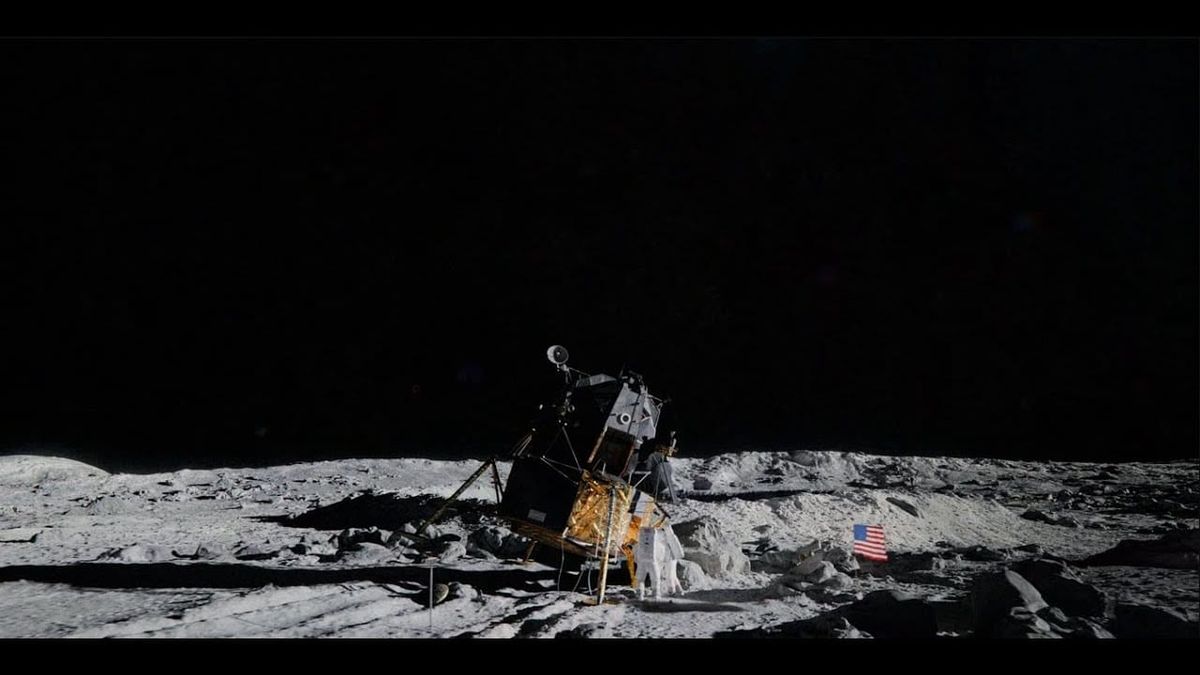
It might not exactly count as science news, but I couldn’t not mention the first US soft-landing on the moon in over half a century, and the first led by a commercial company: the spacecraft Odysseus touched down at crater Malapert A, near the lunar south pole, on 22 February.
Odysseus, built by Houston-based Intuitive Machines, carries a payload of scientific instruments. Some of these were to monitor its descent, others are studying how the environment around the moon – it can’t be called an atmosphere – affects the surface. This is of particular significance near the south pole because that’s where water is believed to exist. How it got there is another matter entirely: the current theory about the moon’s formation is that a celestial body the size of Mars hit the Earth 4.5billion years ago and ripped away a chunk which coalesced in orbit to form our solar system companion. Some scientists believe the energy of this colossal impact created an atmosphere of rock dust, carbon dioxide and water vapour, the last of which rained down onto the young planet, with the high pressure of the CO2 allowing the water to exist as a liquid despite temperatures above 200°C. Could the water on the moon have the same origin? It’s thought to be locked into icy form, in craters which never experience sunlight and are therefore always cold. It’s likely to be a matter for the crew of the Artemis missions which will send humans back to the moon in the coming years, to investigate. Water on the moon means oxygen to breathe, liquid to drink, and fuel for more rocket engines, hopefully enough to fuel the planned next stage of human exploration, on to Mars.
Odysseus’s landing wasn’t smooth. Its instruments indicate it still had some horizontal velocity when it reached the surface, possibly snagging one of its legs on a rock; it’s sitting at a slanted angle. Some readers may not know that this was very nearly the fate of Apollo 11. When Neil Armstrong and Buzz Aldrin approached their planned landing site in July 1969, they found that instead of being flat, the site was a boulder field. Armstrong piloted the Eagle landing module on a hair-raising journey to find a better location, putting the module down flat with only 15 seconds-worth of fuel left in the tanks.
Fortunately for intuitive Machines, all the instruments needed for Odysseus’s experiments are on the sides of the spacecraft facing up. The side facing down carries artworks, which raises the question, if art is tilted onto the moon’s surface so nothing can ever see it, is it still art? It's a high-tech, high-vacuum version of the Zen koan about trees falling in an empty forest. Maybe some small pink knitted creatures might be able to take a look. Or even a cheese-loving plasticene Lancastrian and his dog. That’d be a grand day out.
A couple of years ago summer temperatures in London hit 40°C for the first time, and for reasons that now escape me I walked down to the shops. The temperature itself wasn’t new to me, but the sensation in this familiar setting wad deeply unsettling; it felt wrong. The only relief came from walking past the relatively few house fronts where the owners had cultivated gardens rather than parking areas. The temperature noticeably dropped a few degrees, even if they weren’t in the shade. Of course, this won’t be news to readers in hotter climates. But I was reminded of this reading a news story about a report studying the cooling effect of green spaces in heatwaves.
The Global Centre for Clean Air Research (GCCAR), based at the University of Surrey (in tabloid-speak, Surrey is usually preceded by the adjective “leafy”), produced a study saying that botanic gardens have the biggest effect on air cooling in urbans spaces. Spaces like the Chelsea Physic Garden and Kew Gardens in London (convenient of the Centre’s Guildford-based researchers) or the Gardens by the Bay in more distant Singapore reduced temperatures in surrounding streets by 5°C, the report says (https://www.surrey.ac.uk/news/wetlands-parks-and-even-botanical-gardens-among-best-ways-cool-cities-during-heatwaves). Built environment features like green walls, which we’re seeing more of in London, are almost as effective, giving a 4.7°C cooling effect. Even street trees can have an appreciable effect – but they need to be planted strategically, GCCAR director Prof Prashent Kumar explained to MPs last December. Surrey’s School of Sustainability, Civil and Environmental Engineering has determined that roadside planting can measurably improve air quality (https://www.sciencedirect.com/science/article/pii/S1352231017303151), with low-level hedges having a better effect than tall trees in “street canyons”. In the aforementioned heatwave, Prof Kumar said, areas of Guildford with green planting were 13°C cooler than the bult-up city centre; that’s the equivalent of a refreshing cool breeze compared to standing next to an open oven door. And as for air quality, he said, “If you put trees all over London, the difference would be negligible, but if you strategically put those trees next to the source location, it could reduce the exposure to nitrous oxide by more than half.” To put that in perspective, a 2015 study implicated oxides of nitrogen with 5900 deaths per year in London (https://www.bmj.com/content/351/bmj.h3907).
We all know there’s too much CO2 in the atmosphere. But equally, carbon compounds are valuable and useful. Can we turn the pollutant into the stuff we use? It’s been a subject of speculation for decades. The problem is thermodynamics – the chemical bind between carbon and oxygen is one of the strongest and most stable in nature. Carbon really likes being hugged between a pair of oxygen atoms. Separating them is like crowbarring amorous teenagers apart at the end of a party; a waste of energy. But a startup in Brooklyn – a prime location for amorous teenagers – is trying to do just that and has enlisted as an ally a variant of a venerable industrial chemical process with a dark past.
New Scientist reports (https://www.newscientist.com/article/2416567-inside-the-brooklyn-start-up-making-clean-jet-fuel-with-captured-co2/) that Brooklyn start-up Air Company is electrolysing water into oxygen and hydrogen, reacting the hydrogen with carbon dioxide to make water and carbon monoxide (a mixture known as syngas – the reaction is called “water shift”) and reacting the syngas using a metal catalyst to turn it into hydrocarbons; a different catalyst makes alcohols. The catalysts, unsurprisingly, are secret; one intriguing feature is that both work directly on CO2 and hydrogen without any need for the water shift and synthesis reactions to be separated. The syngas-to-hydrocarbons reaction is a version of a reaction developed in the 1920s. Called the Fischer-Tropsch process, it was most famously used to make liquid hydrocarbon fuels for the German armed forces in World War 2, allowing them to use the country’s coal reserves to make fuel, as Germany has little oil. The company is also reportedly working with NASA on processes that might be used to convert the CO2 rich atmosphere of Mars into useful compounds – a step on from converting the water on the moon into fuel to get to the Red Planet. At least we wouldn’t make the atmosphere of our nearest neighbour any worse.