
Alcedo 1
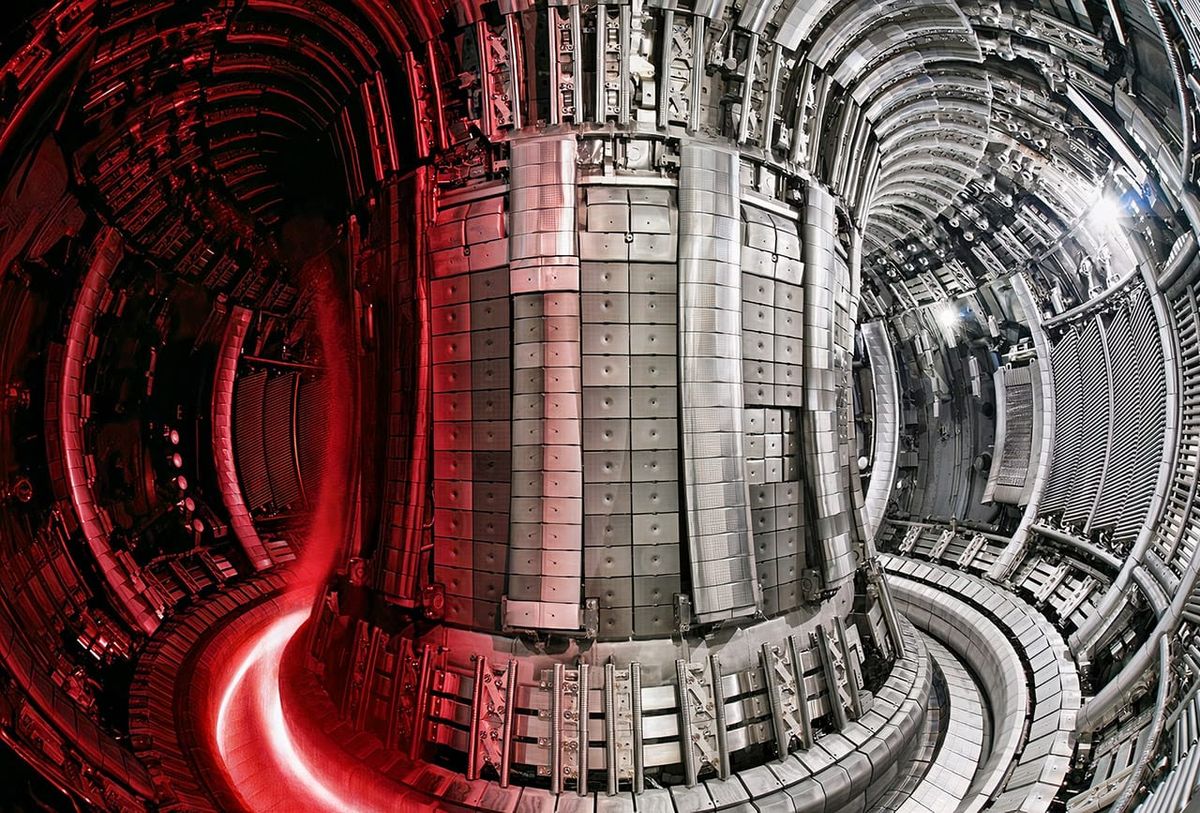
I’ve been writing about nuclear fusion since about 2005 (when, of course, it was supposed to be available by now) so the news about the largest ever amount of energy obtained through it - at JET, the Joint European Torus experimental tokamak in Culham, Oxfordshire, seemed particularly significant. A tokomak is a doughnut-shaped vacuum vessel which contains a low-pressure hydrogen plasma – an electrically charged mixture of isotopes of the element – surrounded by powerful electromagnets which both confine it and force it to circulate at high speeds, providing the conditions to force the particles in the plasma to collide with each other and fuse together, liberating energy in a similar way to how gravity fuses atomic nuclei inside stars – the technique is known as magnetic confinement. Late last year, JET sustained a fusion reaction for 5.2 seconds – 0.2 sec longer than its previous record – generating a power output of 12.5MW while using 0.2mg of fuel.
More than ever before, but still not a lot. And it was JET’s last hurrah: after 40 years in operation and many changes of configuration, the venerable doughnut ceased operations last December, and now enters a 16-year decommissioning phase. The significance of the feat is that it signals a good future for tokomak experiments – notably ITER, the much larger device currently under construction near Marseilles, for which JET was the model in terms of both design and operation, and the UK’s STEP (spherical tokomak for energy production) project, which emerged from studies at Culham and is still based there. Spherical tokomaks resemble cored apples rather than ring doughnuts, which has advantages for the stability of the plasma.
Nobody ever doubted that JET would reach this milestone: tokomaks are an established technology for nuclear fusion. But with ITER plagued by the budget and schedule overruns that affect virtually all multinational high technology projects, it offers concrete proof that building a scaled-up JET will produce valuable physics results and, in time, break records of its own. ITER isn’t designed to generate a single watt of usable electricity, but will instead generate the procedures for operating a working tokomak fusion reactor. In my opinion, tokomaks are more likely to form the basis for fusion power stations than the laser-based inertial confinement of the world’s other large-scale fusion experiment, the National Ignition Facility (NIF) in California.
We’re still a long way from a fusion power station . Neith NIF nor ITER will develop or test a vital step in the process – making tritium, the hydrogen isotope which is a component of fusion fuel and does not occur in nature, from lithium, which will also form part of the job of extracting the heat generated by the fusion reaction and converting it into a form that can be used to generate electricity. But if usable electricity is the omelette, performing fusion is breaking the eggs, and making tritium and converting heat is beating them and melting the butter in the frying pan.
Also catching my eye was an intriguing way to harvest gold from defunct electronics. Described in the journal Advanced Materials, the technique uses an aerogel to absorb gold from a soup made by dissolving the motherboards of discarded devices in aqua regia (mixed hydrochloric and nitric acids). The aerogel in question is made by extracting protein fibres from the whey recovered from strained milk – a food industry waste product that’s usually discarded – linking them together with an acid, then freezing and cooking the crosslinked protein product. Burning away the aerogel once it has absorbed the gold yields metal nuggets of 90 percent purity, the rest being mostly copper.
The attraction of using one waste stream to get something valuable out of another is obvious. Gold mining is a highly polluting industry, and illegal mining is a huge problem, notably in South America, where for example in 2021, some 20,000 illegal miners were estimated to be working in an area of the Amazon rain forest around the size of Portugal that is home to an indigenous group called the Yanomami, polluting river waters with mercury, which they use to dissolve and extract gold from rock (source: https://www.bbc.co.uk/news/world-latin-america-57157017). Using electronics waste as a source of gold is, oddly, likely to be increasingly the most efficient way to obtain the precious metal.
The Dairy sector, likewise, is a huge source of waste in many countries with a tradition of cheesemaking (in the UK, for example, government statistics say that between 250 million and 300million litres of milk are used just to make cheddar cheese every month), and according to Eurostat 80-90 percent of that volume is discarded as whey: In Europe, it says, 54.8million tonnes of liquid whey was generated in 2020. Recent innovations have found food uses for whey, but much of it is still discarded and this intriguing application could be truly significant in helping to solve two sets of problems. It may require legislation to encourage this, and electronics companies will have a role to play in driving demand.
I’ve only recently become aware of the existence of so-called “gold hydrogen”. Although it is the most common elements in the universe, elemental hydrogen has been thought to be relatively rare on Earth . But gold hydrogen, a nickname for geological hydrogen, has now been found in several locations around the world. It occurs underground and may have several sources, including seepage through the deep layers of the mantle from reserves formed along with the planet itself, While it is also generated when groundwater comes into contact with bedrocks containing significant levels of iron in a process called serpentisation, where iron and water react together to form iron oxide and hydrogen. Explorations are underway in the Midwest United States and in Oman, where Tectonic activity has forced an iron-rich continental plate upwards towards the surface. There may be very large quantities Of Gold hydrogen in Several locations around the world, some geologists believe, and this could be a valuable alternative to fossil fuels, as hydrogen burns without generating carbon dioxide. Heather, caution is needed because this still requires drilling for gas, and inherently polluting and risky industry. Moreover, hydrogen is a more difficult guess to handle than methane because its lower molecular weight increases its tendency to escape from storage and it is explosive under certain conditions. These, however, are problems which engineering is well placed to solve.