Let's eat grandma
My eye was caught this week by a feature article about the history of human cannibalism To be precise, I first saw it thanks to a comment by a friend enquiring “Did a cannibal write this?” (https://www.newscientist.com/article/mg26134783-600-is-it-time-for-a-more-subtle-view-on-the-ultimate-taboo-cannibalism).
It’s a long article, setting out the very long history of cannibalism as attested by marks on human bones (all the different species of human, from the now-extinct ones to homo sapiens, such as butchery marks on bones found in Gough’s Cave at Cheddar Gorge in Somerset). The article pointed out that cannibalism isn’t always an indication of savagery; some of the remains indicate that it was a ritual act (some cut marks on bones form complex jig-jag or spiral patterns: that’s not butchery), and eating the remains of the deceased may have indicated respect in these long-vanished societies. After all, ancient humans had brains and minds exactly as sophisticated as our own, and there’s no reason to believe that their societies didn’t have rules as complex as ours, even if we can’t agree with their ideas of morality.
I’m not writing this to suggest we should snack on our grandparents. Funerals are awkward enough occasions as it is. As I currently have a captive audience, I’m doing it to promote one of my favourite writers. I often find out about science snippets from novels, because novelists research deeply and often stumble across information long before science writers collate them into features (which often happens because of a new paper or clutch of papers). I first heard of this sort of respectful cannibalism from a novel published in 1996: Strandloper, by Alan Garner (in my opinion the best writer currently working in English). Strandloper is the story of William, an 18th century Cheshire man, convicted and transported to Australia in a spurious charge because a local landowner feared he might foment revolt among his tenants, who escapes captivity, is rescued in the outback by Aborigines, and over time becomes accepted into their society. It’s not a white saviour narrative: he acts as a translator between his adopted people and the English, but doesn’t perform any heroics. On returning to Cheshire, he walks the landscape in the way he learned in Australia. But at a critical point in the story, William’s son is killed and he consumes his kidneys. When returning and meeting an old acquaintance, he’s asked (and you can feel the fear in the questions): “William, were you… cannibal? Did you eat human flesh?” “Aye,” he replies. “Bits. When it mattered.”
Garner write sparse prose that I always think needs to be read aloud. It has the clang and clash of metal on stone in it, the rustle of leaves and the eerie sing-song of children’s chants. He’s best known for the children’s books he wrote as a young man in the late 1960s and early 1970s (The Weirdstone of Brisingamen and its sequels are the best-known, along with the ever-spooky Owl Service, a retelling of a Welsh myth), and is a big influence on the genre of folk horror. More recently , he’s turned increasingly to adult themes (although he rejects the idea of books as being suited to age-groups; he revisited his most famous books in a belated sequel which daringly suggested that some of the events he’d previously described never actually happened but were imagined as a coping strategy for trauma). His most recent book, Treacle Walker, made him the oldest writer nominated for the Booker Prize at age 88. He’s 90 this year and still writing. He gives the impression of a man who’d never eat anyone, but if he did, it would only be bits. When it mattered.
Space science is one of my regular subjects (I’m interviewing a key engineer in the missions to return humans to the moon tomorrow) but one of the big issues facing space scientists at the moment is that Earth’s orbit is increasingly full of junk: hundreds of old satellites which have reached the end of their lives, bits and pieces discarded from former missions, all sorts. ESA estimated in 2022 that there were 36,500 pieces bigger than 10cm, a million between 1cm and 10cm, and 130million bits smaller than 1cm (some of these are sure to be microscopic particles). Most of these are made from the most common material for space engineering aluminium. Lightweight and strong, aluminium is well-suited for launching into space, when every milligram matters. We tend to think of it as pretty inert stuff, because we’re so used to seeing it, looking shiny and silver on aircraft and even as our familiar kitchen foil.
But aluminium only has these properties because it acquires a layer of transparent oxide which protects the metal surface (incidentally, this transparent oxide was the source of the “transparent aluminium” so famous from the Star Trek film where it was used to make holding tanks to contain humpback whales on a spaceship; some mobile phones now have screens made from a real-life version of this material). But aluminium is in fact quite a reactive metal, similar in its subatomic structure to magnesium whose glaring white flame is familiar from chemistry lessons. Research carried out at the university of British Columbia suggests that tiny aluminium particles in orbit could deplete the ozone layer and reduce the amount of sunlight reaching the Earth; moreover, of course, chunks of metal floating in space are hazardous to operating satellites and spacecraft.
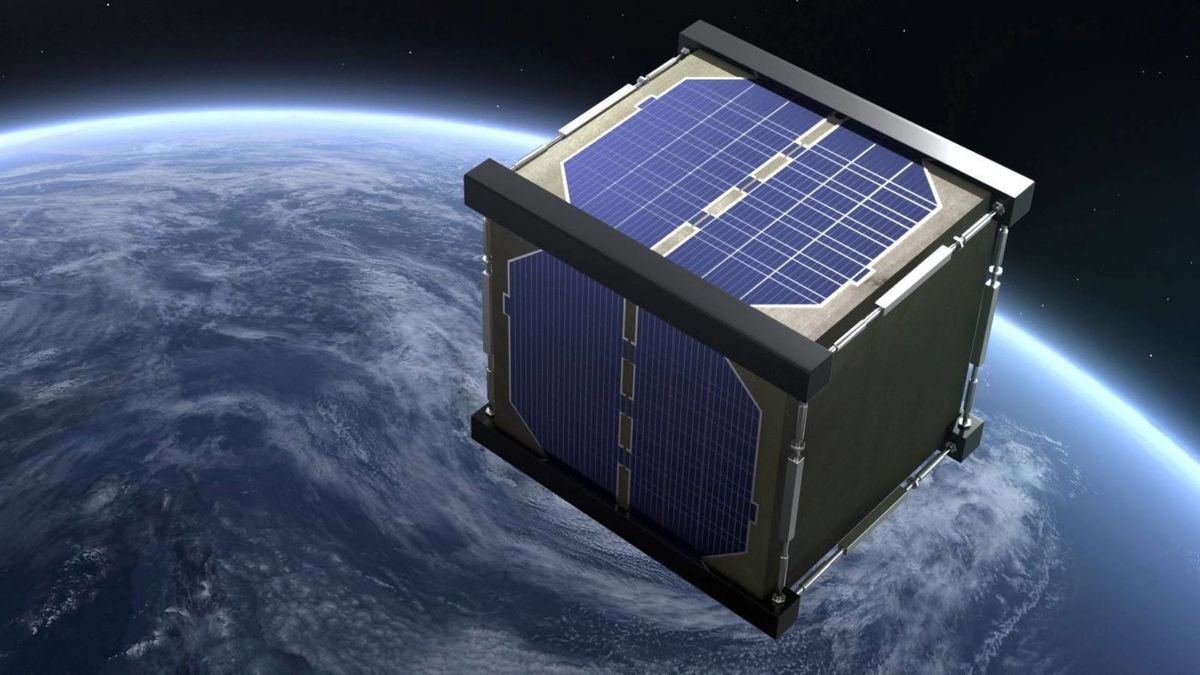
To reduce these risks, astronauts on the International Space Station have been investigating whether wood could be an alternative to aluminium for spacecraft construction. Starting in 2020, studies led by Kyoto university have ben looking sat the properties of various woods, including Japanese Cherry, but the best option appears to be magnolia wood, which appears to not experience any loss of mass or dimensional changes under the conditions found in orbit; possibly because there’s no oxygen to make it rot, or microorganisms to consume it. Magnolia is a prized wood in Japanese craft; I’m a keen cook and own a couple of magnolia protective sheaths for precious Japanese kitchen knives. It’s very resistant to moisture, handy if the knives get put away before they’re fully dry.
The Kyoto team, led by Koji Murata, and working with Sumitomo Forestry, has now built a small satellite from magnolia, called LignoSat2. About the size of a coffee mug (a common size for small research satellites – they’re known as microsats), the craft is scheduled for launch later this year, possibly from one of SpaceX’s Dragon spacecraft which are regularly used to resupply the ISS. It’s expected to operate for about six months, during which time it will be monitored to see whether the wood maintains its shape and integrity. When it burns up on re-entry, the carbonised remnants are not expected to cause any of the issues associated with aluminium, and if any of it reaches the ground it will be biodegradable.
I’m currently working on a feature about non-scary uses of AI – ones which improve the operation of medical devices and don’t use confidential data, threaten jobs or plagiarise copyrighted work. And I recently became aware of another one: it’s called Imageomics, and it might help us better understand and protect the natural world.
Like other AI applications, imageomics are pretty new. The first major centre studying it, at Ohio State University, was only founded in 2021. And again like other AI, it works by analysing large sets of data. In this case, the data comes from pictures of animals – from researchers’ camera traps, satellite images or even tourist photos posted on open-access sites. At a meeting of the American Association for the Advancement of Sciences last week, Imageomics institute director Tanya Berger-Wolf explained how the technique is already helping explain how phenotype (the observable properties of an organism) are related to its genome (https://aaas.confex.com/aaas/2024/meetingapp.cgi/Paper/32018). One example of this, she explained, is in butterfly species which superficially look so similar to other species that humans (and birds, their natural predators) can’t tell them apart. This mimicry evolved so that the species resemble butterflies toxic to predators, but the butterflies themselves can recognise each other for mating. Machine learning can recognise the very subtle differences between the toxic species and their mimics.
“We can’t tell them apart because these butterflies didn’t evolve these traits for our benefit. They evolved to signal to their own species and to their predators,” Berger-Wolf said. “The signal is there – we just can’t see it. Machine learning can allow us to learn what those differences are. We are on the cusp of understanding the direct connections of observable phenotype to genotype. We couldn’t do this without imageomics. It is pushing forward both artificial intelligence and biological science.”
An alarming report over the weekend said that a building known as the Wayfarer’s Glass Chapel, designed by architect Lloyd Wright (the son of renowned Frank Lloyd Wright) and located in Palos Verde near Los Angeles, has been closed because the geological instability of its location has rendered it unsafe. Built in 1951 and the venue for weddings in Hollywood’s golden age, the chapel is made of stone, local redwood and clear glass, and is famous for its beauty. But accelerating movements of the land its sits on threaten the building and make it unsafe. As an engineering writer, I’d hope that some technological solution can be found to stabilise the building. But as Lex Luthor (played faultlessly by Alan Garner’s near-contemporary Gene Hackman in the 1978 Superman the Movie) said after an audacious Californian land-grab, “We’ve all got our faults. Mine’s in San Andreas.”